Hermeneutical Asymmetry and the Accountability Crisis: Debunking the myth of “meaningful human control”
Bella Zhao
Volume 2 • Issue 2
Introduction
On January 9th, 2026, the United States Department of War issued a memorandum, calling to “redefine responsible AI,” with its principle being “out with the utopian idealism, and in with the hard-nosed realism.” (Secretary of War) The plan, despite being the tip of the iceberg, aimed to integrate AI systems into both direct warfighting and supportive background intelligence analysis. If actioned, the entire defense chain of command would resemble an AI army, with autonomous systems handling most of the steps in the chain of command. These plans are not isolated to the United States but are a reflection of the global political sphere that are all choosing to take the risk of an imperfectly aligned AI over the risk of running behind in the global AI arms race.
With the race escalating into a global trend, concerns arise over the trust in and the speed of autonomous war systems: the dystopian AI-gone-rogue scenario, operational hallucinations, and a promotion of over-reliance on autonomous systems. Amidst all concerns, the responsibility gap became a leading debate for global scholars and policymakers. Scholars raised the concern that just war (jus in bello) theory requires someone to be held responsible for deaths for a just war to be fought (Sparrow, 67). When an autonomous weapon system comes into place, none of the programmers, the AI itself, nor the commanding officers (the ones giving the order/input) are a satisfactory answer. The programmer is not responsible for an autonomous system they merely trained; the commander is unable to bear responsibility for the far link between orders and specific actions; and the AI cannot be punished in a morally relevant way (Sparrow, 71). This fatalist perspective fundamentally denies autonomous war systems unless an alternative accountable individual can be identified.
Meaningful human control (MHC) arose as the intuitive solution to accountability concerns because presence has traditionally been understood as equivalent to power. It is commonly believed that an overseeing agent has both complete control of decision-making processes and the ability to check and balance. However, this condition has one major assumption—that humans readily understand AI. Not just the by-definition understanding of what the output means, but rather the ready identification that 1) this is not a human-judged decision and 2) how the output is generated. These means of explanation are centrally encoded into the existence of MHC.
According to the Center for a New American Security’s comprehensive study from 2015, meaningful human control spans three degrees. The first is that human operators are making conscious decisions. The second, that they have sufficient information. And the third, that the human operators are properly trained to ensure effective control over the weapon (Horowitz and Schare, 4). However, it is the implausibility of the “second degree”—whether sufficient information can be obtained—that breaks the equation for MHC.
The instinct to fix this with explainable AI is a reasonable solution. However, the problem is not the amount of information disclosed. It is whether the information can be understood. Even a perfectly transparent system with a superbly trained agent would not be able to solve the latter, the fundamental and unconsciously provoking mechanisms that block the path for human operators to make sense of the decisions and outputs generated by autonomous weapon systems.
Adapting Miranda Fricker’s account of hermeneutical injustice, I argue that meaningful human control produces a structural hermeneutical asymmetry—one that wrongs the human operator. This paper traces the wrong through three gaps. The first is the hermeneutic gap, where human and machine do not share the interpretive resources through which mutual understanding is achieved, so the operator’s only information on AI decisions is a series of numbers. The second is the perception gap, where the quantified, data-dressed form of AI output masks the first gap rather than closing it, inducing the operator to trust the machine’s judgment over their own even when that trust is unearned. The third is a responsibility gap: because MHC treats the operator’s mere presence in the loop as sufficient for accountability, it assigns accountability precisely to the one least equipped. Altogether, these three gaps show that MHC is merely an illusory solution to the accountability problem.
Part I. Understanding AI: Hermeneutics
“
If the human agent asks, ‘Why is it suspicious?’ the system responds, ‘It is 75% suspicious.’ No basis — just a smart quantification that pivots away from the vagueness of its own output.
What does it mean to understand AI? Scholars have approached this major concern mainly from the perspective of the black box problem and the limited knowledge humans have of AI systems. However, I am primarily concerned with the philosophical hermeneutic gap and how the autonomous systems do not allow human counterparts to reach sufficient understanding.
Hans-Georg Gadamer’s Truth and Method defines understanding as an event that occurs between an interpreter and what is being interpreted, through a process called the fusion of horizons. These metaphorical horizons—the finite historical standpoint from which interpreters approach something—govern how individuals form the preunderstanding before any encounter with interpretation. As understanding is the process of two horizons meeting together, empirical knowledge of the individual, tradition, culture, and many unquantifiable factors becomes the principle of understanding. (Theodore)
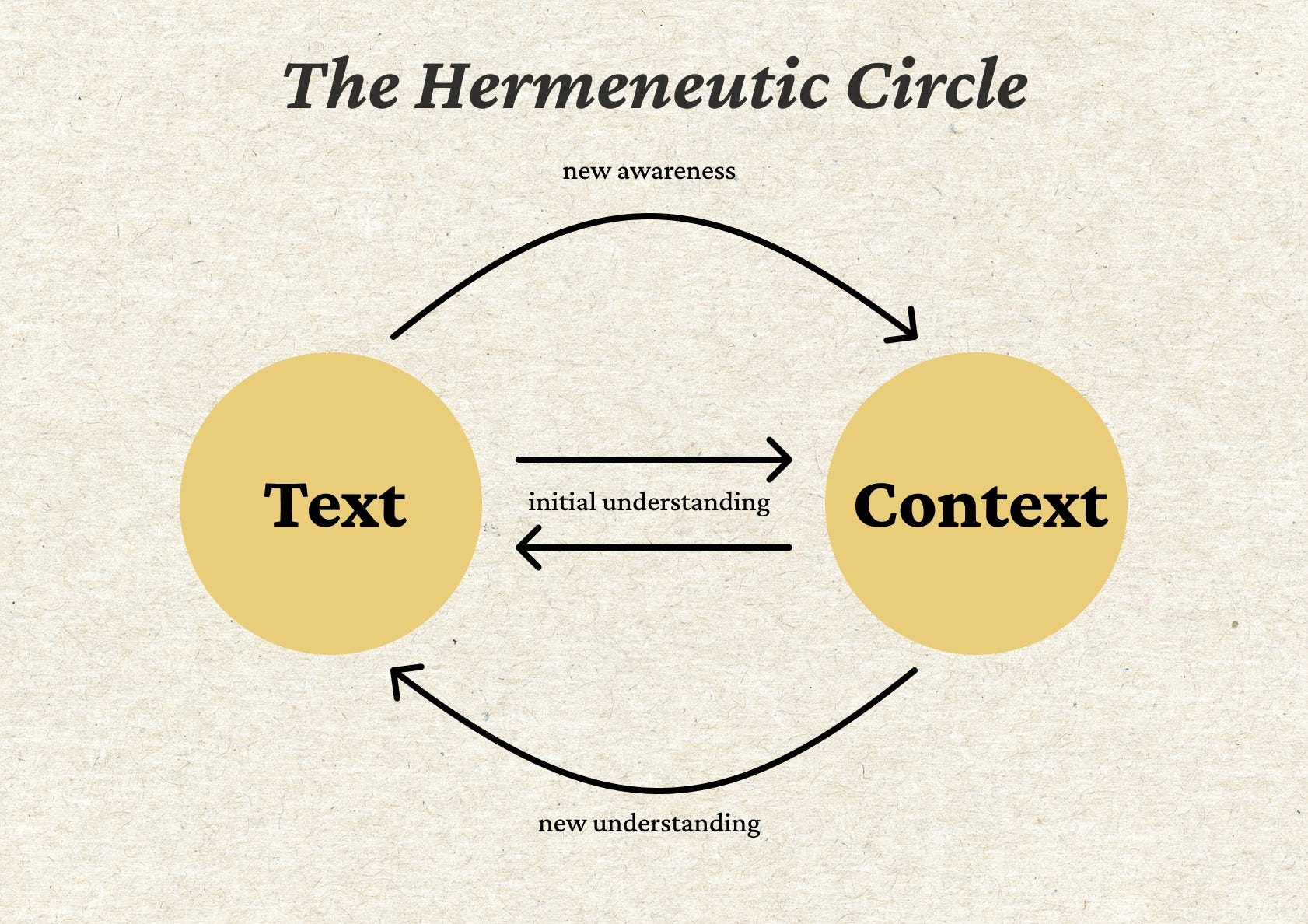
Fig. 1. Diagram showing the hermeneutical circle. Jordan Gibbs.
This model accurately represents how human-to-human understanding occurs, especially under these circumstances: two individuals with enough cross-basing information to create the presumptions needed to fuse the horizons. An analyst and a commander, a soldier and another soldier, spanning similar backgrounds and traditions and sharing nearly identical training, are stellar examples illustrating the prerequisite for understanding. On the contrary, in the case of AI-powered military systems, Gadamer’s model of understanding does not support their
interaction, nor would he argue that the human counterpart has enough information or adequate training to understand the generated information from AI. Distinct from what might be a conversation between two humans of different backgrounds, AI and humans do not share the same type of horizons for a fusion to ever take place.
These relationships do not equate due to the fundamental differences between what a “horizon” means for an AI system and a human as it violates the two conditions of “truth.” First, on tradition. Quantifying tradition, by Gadamer’s account, is impossible. It would mean that first, the training includes all traditions of human existence. Although seemingly contradictory, the primary flaw exists because of the prejudicial nature of tradition. Tradition is prejudicial, but when horizons share a common ground, the prejudices can cancel one another out without necessarily interfering with understanding. But prejudice is unconscious, is unobservable, and cannot be trained into a system. Moreover, even if all tradition has been imputed into AI source banks, to say that humans have enough knowledge to code the neural network is to assume that we know the means to the game. In the words of Theodore George, Gadamer argued, “We (humans) allow ourselves to be oriented by … and hence enable but never determine the thoughts and actions appropriate to playing the game” (George). With no knowledge of the way prejudice influences human response, who’s to say that there’s a way to quantify and resemble the same process on a machine?
Not only do tradition and prejudice fail to translate into AI systems, but the principle differences in how language is perceived are different. Gadamer, according to Theodore George, describes language as the medium and instrument to “show something in its being, as it genuinely is” (George). The AI use of language, consisting of word sequences selected based on projected probability, seems to be fundamentally contradictory to the genuine requirement of language. When the word “suspicious” is programmed to be highly likely related to a series of inputs, it does not truly describe the target but merely plays the role of a highly probable assumption.
Take the example of an analyst reporting to their supervising agent. The analyst reports, “Three targets have been identified as suspicious, and we have reasons to believe that they belong to X target.” According to Gadamer, the supervising agent has sufficient knowledge to understand what “suspicious” means. It means it fits the trend of related sites to the target based on their previous shared experience; it means it passes the qualitative test that they taught the analyst to identify targets from. It means it is different from other military language used to describe the target. This distinct process cannot be replicated in the case of human and AI systems. When an AI reports to its human supervisor, “This target is suspicious.” It does not mean anything—not the fact that it is suspicious by tradition, and not that it is distinctive from other word choices.
Part II. A Gap that Cannot be Seen
From a hermeneutical perspective, human and AI counterparts cannot achieve the fusion of horizons Gadamer requires to achieve understanding. The two lack shared tradition and language. However, it is still the common consensus that humans can understand AI outputs, masking the hermeneutical gap with the perception gap.
Fig. 2. Adapted from Nicolas P. Rougier’s rendering of the human brain
The perception gap appears upon further questioning of the AI system’s output. If the human agent questions, “Why is it suspicious?” the artificial system would respond with, “It is 75% suspicious.” No basis, just a smart quantification that pivots away from the vagueness of its outputs. The gap is not a single-layer problem, but there exists a secondary order of the perception gap. Not only do the human agents fail to hermeneutically understand the AI systems, but they are also unaware of this failed understanding and blatantly trust the AI decisions. Being a relatively new technology known as “intelligence” or “big data,” with tremendous computing power and the “grasp of all human knowledge,” AI-powered systems carry this transparent veil that masks their true identity from the general public.
The perception begins with the label itself, with natural associations of the term “intelligence” with superior knowledge and cognition. Drew McDermott has long raised concerns about the careless naming of systems, arguing in the 1970s that labeling programs as “understanding” is just wishful mnemonics that risk begging the question—preloading the assumption of correctness into the user’s mind. The name, “Intelligence,” already positioned its outputs as a better response to trust for the human operators over their own judgments.
Returning back to the human-AI relationship in military AI systems, the mere function of the autonomous system justifying the output is problematic. The current prevalent explainable AI models all use a secondary algorithm to generate a post hoc explanation, employing a function to approximate what occurs within the black box. Despite being marketed as an interpretable tool, it is merely a prediction and does not accurately reflect the black box (Babic). However, the idea of an explanation creates the illusion of a white box, misleading the human counterpart to take the AI decision as one that is justified.
AI’s numerical justification is more than just a failed explanation; it also shows a vivid attempt at manipulating the human operator into more reliance on the AI outputs. Humans commonly associate numbers with absolute objectivity, believing it acts as a higher truth, especially when compared to inherently flawed and biased individual empirical knowledge. “Numbers don’t lie”—a common saying—accurately reflects how humans perceive quantification. Scholars tend to agree: Theodore Porter theorized that quantification, when used in public life, is more of a political necessity than a scientific one. He argues that officials facing criticism based on biases are most likely to rely on numbers, as it “has at least the appearance of being fair and impersonal.” (Porter, 8) In this case, quantification feeds the moral need for impartiality, significantly lowering the moral burden to trust numbers.
Lavender is a vivid case of how a perception gap implicates military decisions in the real world. The AI targeting system used by Israel in the Palestinian war has raised concern recently due to the unprecedented error rate and shaky justifications. The system uses a numerical score from 1 to 100 estimating the likelihood of a given individual to be a Hamas member, representing Porter’s quantification that is a political necessity. Reportedly, soldiers are also more likely to trust the rational response of machines due to their significant emotional pressure and trauma from the prolonged conflict and killings, placing their own judgment as a lower order of truth compared to absolute objectivity (Abraham).
The perception gap eventually leads to the phenomenon of automation bias, further undermining the ability of human operators to act as the proper check-and-balance for the autonomous war systems. In daily practice, with the natural moral drive to be correct, analysts seem to not be able to control themselves from confirming the AI output/decisions. Without a clear picture of what the AI is—especially as understanding AI seems to be implausible—human supervisors can only follow their “gut,” or in this case, the flawed perception of the true powers of autonomous war systems.
Whether it is quantification, or the myth of intelligence, or the proven automation bias, all actively conceal the absence of truthful understanding with human perception. Meaningful human control not only is less likely to succeed but also causes the human operators to fail unconsciously.
Part III. Just War: Reopening the Accountability Gap
Meaningful human control was supposed to solve the accountability crisis by assigning a human agent that oversees operation and prevents AI flaws and biases. However, at the end of the day, this accountability chain is more procedural than it is substantive. All it does is add in administrative processes to transfer responsibility from AI agents to the more morally acceptable controller—the human agents. When the gaps of hermeneutics and perceptions fundamentally prevent the human operator from achieving meaningful human control, the accountability structure does not substantially change the original responsibility problem.
The weak accountability structure is not the extent of the problem. What is more problematic is the systematic injustice done in this procedural work-around of a real problem. Fricker’s hermeneutical injustice offers a paradigm for visualizing the predicament. Hermeneutical injustice, a wrong done when a gap in collective interpretive resources unfairly disadvantages someone in making sense of their own experience, is used first to describe the initial difficulties in interpreting sexual harassment (Fricker, 149). Although it was solved by a social effort to coin the term, a similar epistemic solution isn’t viable for the case of the human operator. The solution has to be achieving understanding—understanding that is dependent on AI being capable of having a shared history and language, which a statistical model, to the extent of human technology, is not capable of. It is rather a hermeneutical asymmetry for the operator: when first they lack the interpretive resources to understand AI and hence to perform the task of meaningful human control (from the hermeneutical gap), and as they unconsciously fail to perform the task, they are also unable to interpret the undergoing of this failure when all responsibility is placed on them. (from the perception gap).
The injustice done to the human operator is obvious when the three gaps are observed together. The operator is tasked with doing the unachievable: meaningfully controlling something they do not have sufficient information nor adequate training to understand. The operator, by following commands like any regular soldier, has to bear the responsibility of the autonomous system’s actions at the same time. Take the case of the Lavender system, where soldiers were not only unable to understand and correctly perceive AI but also had to do it at shortened speed due to government orders, acting only as a rubber-stamp procedural agent. The same soldiers had to carry the direct punishments or the psychological liability not only for the AI’s actions but also for its 10% error rates (Abraham).
Conclusion
This paper aims to test the underlying assumption of meaningful human control: that presence equates to ability, that a rubber-stamping human operator can meaningfully understand and be held responsible for autonomous war systems. While this paper first approached this problem with Gadamer’s account of hermeneutics and understanding to show the implausibility of understanding in a human-machine conversation, some might still argue that even partial understanding is sufficient enough for human judgment. However, section II then serves as the supplementary discussion, pointing out the complex problem structure as the problem is deeply buried under perception gaps like quantification and association. In the end, not only does the accountability structure get undermined due to the problem with meaningful human control, it furthers a moral implication of the hermeneutical asymmetry. A distinction from Fricker’s hermeneutical injustice, describing how the operator is wronged, personally and structurally, by being held to a standard of understanding the relationship itself makes it impossible to meet.
The three gaps, fundamental hermeneutical differences, and the masking perception gap and the accountability gap reopen Sparrow’s fatalist view. Despite a fourth actor, the human counterpart to the autonomous war system, being considered the fourth candidate against the original three moral actors, there still remains no easy answer as to who bears the responsibility of death. If the need for just war is the global consensus, then autonomous weapon systems are a few steps away from appropriate entry into military operations.
This paper is by no means calling for a end to meaningful human control, as it appears to be one of the only viable measures limiting the rapid development of military AI systems. However, to avoid setting a precedent in which Lavender-style operators are rubber-stamped into bearing tremendous accountability, the military should develop a better accountability structure alongside its continued work on AI systems—whether through prompt engineering, clearer input-output structures, or technical advancement in creating actual interpretable AI. While developmental successes await, policymakers should hesitate to be overly confident of their autonomous war systems and their ability to properly control them. A global arms race has never been easily stoppable, but only with a clear vision of the current problem can there be any means of risk mitigation.
Works Cited
Abraham, Yuval. “‘Lavender’: The AI Machine Directing Israel’s Bombing Spree in Gaza.” 3 Apr. 2024.
Babic, Boris, et al. “Beware Explanations from AI in Health Care.” Science, vol. 373, no. 6552, 15 July 2021, pp. 284–286, 10.1126/science.abg1834.
Fricker, Miranda. “Hermeneutical Injustice.” Epistemic Injustice, 1 June 2007, pp. 147–175, 10.1093/acprof:oso/9780198237907.003.0008.
George, Theodore. “Hermeneutics.” The Stanford Encyclopedia of Philosophy, edited by Edward N. Zalta and Uri Nodelman, Metaphysics Research Lab, Stanford University, 30 Apr. 2025, plato.stanford.edu/entries/hermeneutics/.
Gibbs, Jordan. “The Most Esoteric ChatGPT Prompt.” Medium.com, 15 Nov. 2025,
https://medium.com/@jordan_gibbs/the-most-esoteric-chatgpt-prompt-3ff028a6f84a
Horowitz, Michael, and Paul Scharre. Meaningful Human Control in Weapon Systems: A Primer.
Mar. 2015,
https://www.files.ethz.ch/isn/189786/Ethical_Autonomy_Working_Paper_031315.pdf. Accessed 25 July 2026.
McDermott, Drew. “Artificial Intelligence Meets Natural Stupidity.” ACM Sigart Bulletin, no.
57, 1 Apr. 1976, pp. 4–9, 10.1145/1045339.1045340.
Porter, Theodore M. Trust in Numbers : The Pursuit of Objectivity in Science and Public Life. Princeton, N.J., Princeton University Press, 1995.
Secretary of War. “Artificial Intelligence Strategy for the Department of War.” Memorandum for Senior Pentagon Leadership, Department of War, 9 Jan. 2026, https://media.defense.gov/2026/Jan/12/2003855671/-1/-1/0/ARTIFICIAL-INTELLIGEN CE-STRATEGY-FOR-THE-DEPARTMENT-OF-WAR.PDF. Accessed 25 July 2026.
Sparrow, ROBERT. “Killer Robots.” Journal of Applied Philosophy, vol. 24, no. 1, Feb. 2007, pp. 62–77, 10.1111/
j.1468-5930.2007.00346.x.
Zając, Maciek. “Punishing Robots – Way Out of Sparrow’s Responsibility Attribution Problem.” Journal of Military Ethics, vol. 19, no. 4, 1 Oct. 2020, pp. 285–291, 10.1080/15027570.2020.1865455.